


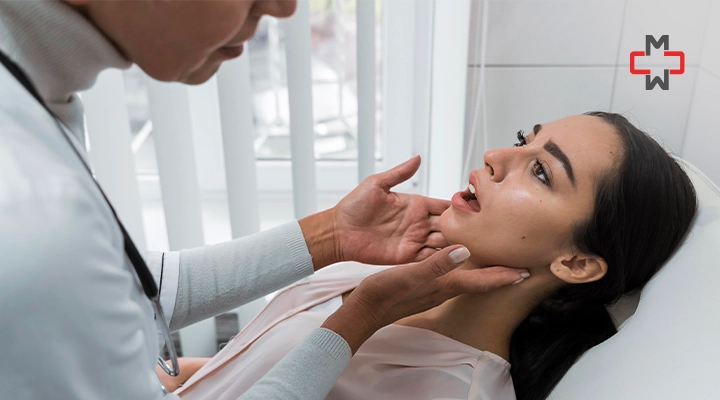
Herpes in throat can happen when herpes simplex virus, usually HSV-1 or sometimes HSV-2, infects the mouth, tonsils, back of the throat, or rarely the esophagus. It may cause painful throat sores, sore throat, trouble swallowing, swollen glands, fever, fatigue, and mouth ulcers.
For many people, throat herpes feels like a severe sore throat with painful swallowing, but it can be confused with strep throat, tonsillitis, mono, canker sores, oral thrush, or another sexually transmitted infection. According to Dr. Syra Hanif, M.D., a board-certified primary care physician at Manhattan Medical Arts, anyone with painful throat sores after kissing, oral sex, or possible HSV exposure should avoid self-diagnosing and consider proper medical testing.
If you have throat pain, sores, fever, or possible exposure to an STI, Manhattan Medical Arts offers herpes testing in NYC, same-day STD testing, primary care, and online doctor visits when symptoms are appropriate for telehealth.
Quick Answer: Can You Get Herpes in Your Throat?
Yes, you can get herpes in your throat. Herpes simplex virus can infect the mouth and throat through direct contact with infected saliva, oral sores, genital sores, or mucous membranes. This can happen through kissing, oral sex, or close contact with someone who has HSV, even if visible sores are not present.
Cleveland Clinic explains that oral herpes is caused by herpes simplex virus, and both HSV-1 and HSV-2 can cause oral herpes, although HSV-1 causes most oral cases. HSV can affect the lips, mouth, gums, tongue, palate, throat, and nearby tissues. In some cases, especially in people with weakened immune systems, HSV can affect the esophagus, which is called herpes esophagitis.
Herpes in throat is not the most common form of oral herpes, but it can happen. Because many throat infections look similar, testing is often needed to confirm the cause.
What Is Herpes in Throat?
Herpes in throat refers to a herpes simplex virus infection involving the throat area. It may affect the back of the throat, tonsils, uvula, soft palate, mouth, or pharynx. In more serious cases, HSV can involve the esophagus, the tube that carries food from the mouth to the stomach.
The infection may be caused by:
- HSV-1, which commonly causes oral herpes and cold sores
- HSV-2, which more often causes genital herpes but can infect the mouth or throat through oral sex
The term “throat herpes” is often used by patients, but a medical provider may describe it as oral herpes, HSV pharyngitis, herpetic pharyngitis, herpetic tonsillitis, or herpes esophagitis depending on the exact location and severity.
Herpes in the throat can appear during a first HSV infection or as a recurrence. First outbreaks are often more intense because the immune system has not previously learned to control the virus.
What Causes Herpes in the Throat?
Herpes in the throat is caused by contact with herpes simplex virus. HSV spreads through direct contact with infected skin, saliva, mucous membranes, or sores.
Possible transmission routes include:
- Kissing someone with oral herpes
- Oral sex with someone who has genital HSV
- Contact with saliva during an active outbreak
- Sharing objects that may carry saliva during an outbreak, such as utensils or lip balm
- Skin-to-skin contact with an infected area
- Exposure during asymptomatic viral shedding
Asymptomatic shedding means the virus can sometimes spread even when a person has no visible sores. This is one reason HSV transmission can happen without either person realizing it.
CDC notes that antiviral medication can treat HSV outbreaks and that people with HSV should avoid sex during lesions or prodromal symptoms. A prodrome is an early warning phase when tingling, burning, pain, itching, or irritation starts before sores appear.
Is Throat Herpes an STD?
Throat herpes can be sexually transmitted if HSV spreads to the throat during oral sex. However, not every case of oral or throat herpes comes from sexual contact. HSV-1 is commonly spread through nonsexual contact, including kissing or saliva exposure, often earlier in life.
So the answer depends on how the infection was acquired:
| Situation | Is It Sexually Transmitted? |
| HSV in throat after oral sex | Yes, it may be sexually transmitted |
| HSV from kissing someone with oral herpes | Not necessarily an STD, but still contagious |
| Childhood HSV-1 exposure | Usually nonsexual |
| HSV-2 in throat after oral sex | Usually sexually transmitted |
| Recurrent oral herpes | May reactivate from a past infection |
If throat symptoms started after oral sex, new sexual exposure, or contact with a partner who has HSV, testing is the safest way to understand what is happening. A confidential STD testing visit can help check for herpes and other infections that may cause throat or genital symptoms.
Herpes in Throat Symptoms
Herpes in throat symptoms can vary from mild irritation to severe pain. Some people have no symptoms, while others develop obvious sores and difficulty swallowing.
Common symptoms include:
- Sore throat
- Painful swallowing
- Burning or raw feeling in the throat
- Small blisters or ulcers in the mouth or throat
- Sores on the tonsils, uvula, palate, tongue, gums, or back of throat
- Swollen lymph nodes in the neck
- Fever
- Fatigue
- Body aches
- Headache
- Bad breath
- Reduced appetite
- Trouble eating or drinking
Cleveland Clinic lists fever, sore throat, throat redness and swelling, and painful sores inside the mouth as possible oral herpes symptoms. These symptoms may be more noticeable during a first outbreak.
Herpes throat symptoms can feel similar to strep throat or tonsillitis. The difference is that HSV often causes painful blisters, ulcers, or mouth sores, while strep throat usually causes fever, throat pain, swollen tonsils, and sometimes white patches without typical herpes blisters.
What Does Throat Herpes Look Like?
Throat herpes may look like small painful blisters, ulcers, red patches, or open sores in the mouth or throat. The sores may appear on the tonsils, uvula, roof of the mouth, back of the throat, gums, tongue, or inner cheeks.
Herpes sores may:
- Start as small fluid-filled blisters
- Break open into painful ulcers
- Have a white, yellow, or gray center
- Have red edges
- Appear in clusters
- Cause burning or stinging pain
- Make swallowing painful
It is important not to diagnose herpes in throat from pictures alone. Strep throat, tonsillitis, oral thrush, canker sores, hand-foot-and-mouth disease, mono, syphilis, and other infections can also cause throat or mouth lesions.
If you are looking up “herpes in throat pictures” or “what does herpes in throat look like,” use images only as general education. A provider should examine the throat and may need to swab a sore for testing.
First Stage Herpes in Throat Symptoms
The first stage of herpes in throat may begin before visible sores appear. Some people notice early warning symptoms, also called prodromal symptoms.
Early stage throat herpes symptoms may include:
- Tingling in the mouth or throat
- Burning sensation
- Throat irritation
- Mild soreness
- Swollen glands
- Fatigue
- Fever
- Body aches
- Headache
- Pain before sores appear
After the early stage, small blisters or ulcers may develop. These sores can become very painful, especially when swallowing, eating acidic foods, or drinking hot beverages.
Merck Manual explains that first oral HSV infections can cause many painful mouth sores with fever, headache, body aches, and difficulty eating or drinking. Severe mouth or throat pain can lead to dehydration if a person cannot drink enough fluids.
Herpes in Throat After Oral Sex
Herpes in throat after oral sex can happen if the mouth or throat comes into contact with HSV from genital skin, genital sores, or infected secretions. HSV-2 can infect the throat through oral sex, and HSV-1 can also spread between oral and genital areas.
Symptoms may appear days after exposure, but timing varies. Some people never develop symptoms, while others have a first outbreak with painful throat sores, fever, swollen glands, and fatigue.
You should consider testing if:
- Throat sores appeared after oral sex
- Your partner has oral or genital herpes
- You have painful swallowing with mouth ulcers
- You also have genital sores, burning, or itching
- You have had a new sexual partner
- You are unsure whether symptoms are herpes, strep, or another STI
If you are concerned about exposure, Manhattan Medical Arts offers same-day STD testing in NYC. If you are unsure about timing, the guide on how long an STD test takes may help you understand when results may be available.
Throat Herpes vs Strep Throat, Tonsillitis, Mono, Canker Sores, and Thrush
Throat herpes can be mistaken for several other conditions. This is why diagnosis should not be based on symptoms alone.
| Condition | Common Symptoms | Key Difference |
| Herpes in throat | Painful blisters or ulcers, sore throat, fever, swollen glands | Sores may appear in clusters and can follow HSV exposure |
| Strep throat | Fever, sore throat, swollen tonsils, white patches | Usually bacterial and diagnosed with rapid strep or throat culture |
| Tonsillitis | Swollen tonsils, sore throat, fever, trouble swallowing | Can be viral or bacterial, not always HSV |
| Mono | Severe fatigue, sore throat, swollen glands, fever | Often linked with extreme fatigue and enlarged lymph nodes |
| Canker sores | Painful ulcers inside mouth | Not caused by HSV and not contagious |
| Oral thrush | White patches, soreness, cottony mouth feeling | Caused by Candida yeast, not HSV |
| Syphilis chancre | Usually painless sore | Requires STI testing and antibiotic treatment |
If your main symptom is sore throat without clear sores, you may need evaluation for strep, viral infection, tonsillitis, COVID, flu, or mono. Manhattan Medical Arts offers sore throat treatment in NYC for patients who need diagnosis and care.
Is Strep Throat Herpes?
No, strep throat is not herpes. Strep throat is a bacterial infection caused by group A Streptococcus. Herpes in throat is caused by herpes simplex virus.
However, both can cause sore throat, swollen glands, fever, and pain with swallowing. This overlap can make it hard to tell the difference without testing.
Strep throat usually requires antibiotics if confirmed. Herpes is treated with antiviral medication when appropriate. Taking the wrong medication will not treat the correct cause, so diagnosis matters.
Herpes Esophagitis: When HSV Affects the Esophagus
Herpes esophagitis happens when HSV infects the esophagus. This is less common than oral herpes and is more likely in people with weakened immune systems, although it can occasionally occur in otherwise healthy people.
Possible herpes esophagitis symptoms include:
- Severe pain with swallowing
- Chest pain
- Pain behind the breastbone
- Trouble eating
- Trouble drinking
- Fever
- Nausea
- Vomiting
- Weight loss from poor intake
- Dehydration
Herpes esophagitis can be serious because it may prevent a person from drinking enough fluids or eating. People with HIV, cancer treatment, organ transplant medications, long-term steroids, or other immune system problems should seek care quickly if they develop painful swallowing or chest pain with suspected HSV.
If you are asking “can herpes cause chest pain,” the answer is yes, but chest pain should never be assumed to be herpes. Chest pain can also come from heart, lung, reflux, infection, or other serious causes. Severe chest pain, trouble breathing, fainting, or pressure-like chest pain needs urgent evaluation.
How Is Herpes in the Throat Diagnosed?
Herpes in throat is diagnosed through a medical history, physical exam, and testing when needed. A provider may examine the mouth, throat, tonsils, neck lymph nodes, and any visible sores.
Testing may include:
- HSV swab from a fresh sore
- PCR testing from a lesion
- Viral culture, less commonly
- Blood test for HSV antibodies
- Strep test
- Mono test
- COVID or flu testing if symptoms fit
- STI testing if exposure is possible
A swab from a fresh sore is often the most useful way to confirm active HSV at that location. Blood tests can show past exposure to HSV-1 or HSV-2, but they usually cannot prove that current throat symptoms are caused by herpes.
If throat symptoms appeared after sexual exposure, it may be appropriate to test for other STIs too. This is because gonorrhea, chlamydia, syphilis, and other infections can affect the throat after oral sex.
Herpes in Throat Treatment
Herpes in throat treatment usually focuses on antiviral medication, pain control, hydration, and preventing transmission. Treatment depends on symptom severity, timing, medical history, and whether this is a first outbreak or a recurrence.
Common antiviral medications include:
- Acyclovir
- Valacyclovir
- Famciclovir
CDC states that acyclovir, famciclovir, and valacyclovir are antiviral medications used for HSV, and episodic therapy works best when started within one day of lesion onset or during the prodrome. This means early treatment matters.
Supportive care may include:
- Drinking cool fluids
- Avoiding acidic or spicy foods
- Eating soft foods
- Using pain relievers recommended by a provider
- Using throat-soothing measures
- Avoiding alcohol and smoking
- Resting
- Avoiding kissing and oral sex during symptoms
Do not use leftover antivirals or someone else’s medication. Treatment should match your symptoms, health history, pregnancy status, kidney function, immune status, and diagnosis.
How Long Does Herpes in Throat Last?
Herpes in throat may last about 1 to 2 weeks in many mild cases, but the timeline can vary. First outbreaks may last longer and feel more severe than later outbreaks. Severe oral HSV infections can make eating and drinking difficult.
Mayo Clinic notes that cold sores often clear without treatment in 2 to 4 weeks, and antiviral medication may speed healing. Throat involvement may feel different from lip cold sores, but the general principle is similar: HSV sores often improve over time, and antivirals may shorten or reduce symptoms when used appropriately.
Symptoms that last longer than expected, worsen, or cause dehydration should be evaluated. A person who cannot swallow fluids, has high fever, severe pain, or chest pain should not wait at home.
Can Herpes in Throat Be Cured?
Herpes in throat symptoms can be treated, but HSV itself is not cured. After the first infection, the virus stays in the body in a dormant state and may reactivate later.
This does not mean symptoms are constant. Many people have rare outbreaks or no noticeable recurrences. Others have recurrent oral or genital outbreaks.
Treatment can help:
- Shorten outbreaks
- Reduce pain
- Support healing
- Lower outbreak frequency in some people
- Reduce transmission risk when suppressive therapy is used
If outbreaks are frequent or severe, a provider may discuss suppressive antiviral therapy.
Can You Spread Throat Herpes?
Yes, throat herpes can spread to others. HSV can spread through saliva, oral sores, mucous membrane contact, kissing, oral sex, and skin-to-skin contact with infected areas.
Transmission risk is higher when sores are present, but HSV can sometimes spread when no sores are visible.
To reduce spread:
- Avoid kissing during symptoms
- Avoid oral sex during symptoms
- Do not share lip balm, utensils, cups, or razors during an outbreak
- Wash hands after touching the mouth or sores
- Avoid touching sores
- Use barriers such as condoms or dental dams during oral sex
- Discuss HSV status with sexual partners
- Ask a provider about antiviral therapy if outbreaks are frequent
If you have active throat or mouth sores, wait until sores are fully healed before kissing or having oral sexual contact.
When to See a Doctor
You should see a doctor if you think you may have herpes in throat, especially if symptoms are painful, new, severe, or linked to sexual exposure.
Seek medical care if you have:
- Painful throat sores
- Trouble swallowing
- Fever
- Swollen neck glands
- Mouth or throat ulcers
- Symptoms after oral sex
- New partner exposure
- Recurrent outbreaks
- Symptoms that do not improve
- Possible STI exposure
- Pregnancy
- Weakened immune system
Seek urgent care right away if you have:
- Trouble breathing
- Inability to swallow fluids
- Dehydration
- Severe chest pain
- Severe neck swelling
- Confusion
- Very high fever
- Eye pain or vision changes
- Severe symptoms in a newborn or infant
Dr. Syra Hanif, M.D. recommends prompt evaluation when throat sores are severe or when symptoms occur after possible STI exposure. Early diagnosis can help guide the right treatment and reduce the chance of spreading infection.
Can You Use Telehealth for Herpes in Throat?
Telehealth may be useful for mild symptoms, follow-up care, medication questions, or discussion of possible exposure. However, herpes in throat sometimes requires an in-person exam or swab from a sore.
An online doctor visit may be appropriate if:
- Symptoms are mild
- You have a known history of HSV
- You need guidance about antiviral medication
- You need to discuss testing options
- You are not having trouble swallowing or breathing
In-person care is better if:
- This is your first suspected outbreak
- You have severe throat pain
- You have trouble swallowing
- You have fever and swollen glands
- You need a swab test
- You may have strep throat, mono, or another STI
- You have chest pain or dehydration symptoms
How Manhattan Medical Arts Can Help
Manhattan Medical Arts can help evaluate herpes in throat, sore throat, oral sores, and possible STI exposure through primary care, STD testing, herpes testing, sore throat evaluation, and telehealth when appropriate.
Depending on your symptoms, care may include:
- Medical history review
- Mouth and throat exam
- HSV testing
- STD testing
- Strep or mono testing if needed
- Antiviral treatment when appropriate
- Pain relief recommendations
- Hydration guidance
- Counseling about transmission prevention
- Follow-up care for recurrent outbreaks
Patients in Manhattan, Forest Hills, and across NYC can schedule herpes testing, STD testing, a primary care appointment, or sore throat treatment depending on symptoms.
For ongoing sexual health and routine screening, preventive care can also help identify risks early and support long-term health.
Frequently Asked Questions
How do I tell if I have herpes in my throat?
You may suspect herpes in throat if you have painful throat sores, mouth ulcers, swollen glands, fever, and painful swallowing, especially after kissing or oral sex with someone who may have HSV. Testing is the only reliable way to confirm it.
What causes herpes in the throat?
Herpes in the throat is caused by herpes simplex virus. HSV-1 causes most oral herpes cases, but HSV-2 can also infect the throat through oral sex.
Is throat herpes an STD?
It can be. Throat herpes may be sexually transmitted through oral sex, especially if HSV-2 is involved. But oral HSV-1 can also spread nonsexually through kissing or saliva contact.
Does herpes go away?
The sores and symptoms usually go away, but the virus stays in the body. HSV can become dormant and reactivate later. Antiviral treatment can help manage outbreaks.
What are the symptoms of herpes in the throat?
Symptoms may include sore throat, painful swallowing, throat ulcers, blisters, swollen lymph nodes, fever, fatigue, mouth sores, and burning or raw throat pain.
How long does herpes in the throat last?
Many cases improve within 1 to 2 weeks, but first outbreaks or severe cases can last longer. Antiviral medication may help shorten symptoms when started early.
What are the stages of herpes in the throat?
The stages may include tingling or burning, throat irritation, blister formation, painful ulcers, crusting or healing, and symptom improvement. Not everyone notices every stage.
How is herpes in the throat treated?
Treatment may include antiviral medication such as acyclovir, valacyclovir, or famciclovir, along with pain relief, hydration, soft foods, and avoiding oral contact during an outbreak.
Can herpes cause chest pain?
Herpes can rarely affect the esophagus, which may cause chest pain and painful swallowing. Chest pain should be evaluated carefully because it can have serious causes unrelated to herpes.
Is strep throat herpes?
No. Strep throat is a bacterial infection, while herpes is viral. They can both cause sore throat and fever, but they require different testing and treatment.
Can herpes appear on the tonsils or uvula?
Yes, HSV sores can appear on the tonsils, uvula, palate, mouth, or back of the throat. Because other conditions can look similar, a medical exam is recommended.
Can herpes in throat be cured?
HSV cannot be permanently cured, but outbreaks can be treated. Antivirals can reduce symptoms, speed healing, and help manage recurrences.
Final Thoughts
Herpes in throat can cause painful throat sores, sore throat, trouble swallowing, swollen glands, fever, and fatigue. It may be caused by HSV-1 or HSV-2 and can spread through kissing, oral sex, saliva, or direct contact with infected sores.
Because throat herpes can look like strep throat, tonsillitis, mono, oral thrush, canker sores, or another STI, testing and medical evaluation are important. At Manhattan Medical Arts, Dr. Syra Hanif, M.D. and the medical team can help evaluate symptoms, provide testing, and recommend treatment based on your condition.
Disclaimer
This blog is for informational & educational purposes only and does not intend to substitute any professional medical advice or consultation. For any health-related concerns, please consult with your physician, or call 911.

-
About The Author
Dr. Syra Hanif M.D.Board Certified Primary Care Physician

Dr. Syra Hanif is a board-certified Primary Care Physician (PCP) dedicated to providing compassionate, patient-centered healthcare.
Read More