


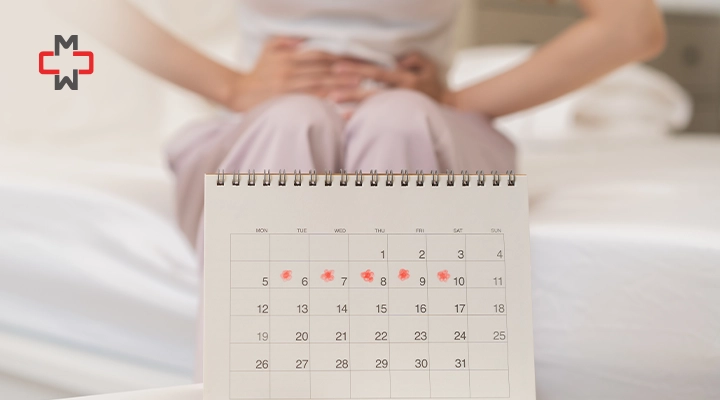
If you are looking for signs of period coming late, the first thing to know is that there is no specific symptom that can reliably predict that your period will be delayed. However, when your expected period has not started, you may still experience familiar premenstrual symptoms such as cramps, breast tenderness, bloating, headaches, backache, fatigue, food cravings, or mood changes. (Office on Women’s Health)
These symptoms may mean your menstrual cycle is progressing toward a period, but they cannot tell you exactly when bleeding will begin. They also cannot reliably distinguish a late period from early pregnancy because breast tenderness, fatigue, bloating, and a missed period can occur during early pregnancy as well. (MedlinePlus)
A period may arrive later than expected because ovulation occurred later that month, or because of pregnancy, stress, weight changes, intense exercise, hormonal birth control, polycystic ovary syndrome (PCOS), thyroid problems, perimenopause, or other medical factors. (ACOG)
At Manhattan Medical Arts, Dr. Syra Hanif, M.D. provides primary care and women’s health services for menstrual and hormonal concerns. (Manhattan Medical Arts)
What Are the Signs of Period Coming Late?
There are no reliable physical signs that can predict in advance that your period will be late. What many people actually notice are their usual PMS symptoms continuing while the expected bleeding has not yet started.
Possible symptoms include:
- Lower abdominal cramps
- Breast tenderness or swelling
- Bloating
- Headaches
- Lower back discomfort
- Fatigue
- Irritability
- Anxiety or mood changes
- Food cravings or appetite changes
- Changes in sleep
The Office on Women’s Health identifies breast tenderness, bloating, cramping, headaches, backaches, fatigue, appetite changes, anxiety, irritability, and mood swings among common PMS symptoms. PMS typically develops after ovulation and before menstruation. (Office on Women’s Health)
However, having these symptoms does not guarantee your period will begin today or tomorrow. The timing of ovulation and the menstrual cycle can vary from one month to another.
What Does It Mean When Your Period Is Late?
A period is generally considered late when it has not started around the time expected based on your usual menstrual pattern.
A menstrual cycle is counted from the first day of one period to the first day of the next. ACOG states that most adult menstrual cycles fall between approximately 21 and 35 days. (ACOG)
That does not mean everyone should have a 28-day cycle.
For example, if your cycles usually last:
- 26 days, reaching day 31 is later than normal for you.
- 32 days, day 30 would not actually be late.
- 27 to 34 days, a few days of monthly variation may already be part of your normal pattern.
Your own cycle history is therefore more useful than comparing yourself with a universal 28-day calendar.
What Are the Signs Your Late Period May Be About to Start?
If your period is already late, some familiar PMS symptoms may appear before bleeding begins.
| Symptom | Common Before a Period? | Can Also Occur in Early Pregnancy? |
|---|---|---|
| Breast tenderness | Yes | Yes |
| Bloating | Yes | Yes |
| Fatigue | Yes | Yes |
| Mild cramps | Yes | Yes |
| Mood changes | Yes | Can occur |
| Headache or backache | Yes | Can occur |
| Food cravings | Yes | Can occur |
| Missed period | Represents the delay | Common early pregnancy sign |
PMS and early pregnancy have enough overlapping symptoms that symptoms alone are not a reliable way to decide whether a late period means pregnancy. (Office on Women’s Health)
If pregnancy is possible, a pregnancy test provides more useful information than trying to interpret individual symptoms.
Why Do I Have Period Cramps but No Period?
Cramps without bleeding can happen when your period is approaching, but cramps do not prove that menstruation will start immediately.
Mild pelvic cramping is a recognized PMS symptom. (Office on Women’s Health)
Several situations can produce period-like cramps without an expected period, including:
- A period that has been delayed by later ovulation
- Early pregnancy
- Hormonal birth control
- PCOS or irregular ovulation
- Other pelvic or gynecologic conditions
The pattern matters.
If the cramps feel similar to your usual premenstrual cramps and the period starts shortly afterward, they may simply be part of that cycle.
However, severe, unusual, persistent, or strongly one-sided pelvic pain should not automatically be treated as PMS, especially if pregnancy is possible.
Can You Have PMS Symptoms but No Period?
Yes. You can experience PMS-like symptoms even when your period has not started at the expected time.
PMS symptoms develop in relation to hormonal changes after ovulation. If the timing of your cycle changes, your predicted period date may no longer accurately reflect what is happening biologically. (Office on Women’s Health)
This explains the common experience:
“I feel like my period is coming, but it still hasn’t started.”
The symptoms may be real, but they do not function as a precise countdown to menstruation.
If this happens repeatedly, tracking the first day of each period and your symptoms can help identify whether your cycles are becoming irregular. The Office on Women’s Health recommends tracking bleeding dates, PMS symptoms, cycle length, and changes from month to month. (Office on Women’s Health)
Can Late Ovulation Make Your Period Late?
Yes. Later-than-usual ovulation can shift the expected date of your next period.
This is one of the most important explanations for an apparently late period.
A menstrual cycle is not simply a fixed 28-day countdown. Ovulation timing can vary even within the same person.
A 2026 prospective study following menstrual cycles for up to 12 cycles found substantial within-person variation. Cycle length varied by at least one week in 62.4% of participants, and ovulation timing varied by at least one week in 54.8%. (PubMed)
In simple terms:
If ovulation happens later, the next period often comes later too.
This is also why period-tracking apps provide estimates rather than guarantees. An app may predict your period based on previous cycles, but it cannot always know when ovulation actually occurred during the current cycle.
Late Period or Pregnancy: Can You Tell From the Symptoms?
Usually not with confidence. PMS and early pregnancy share several symptoms.
For example:
PMS may cause
- Tender breasts
- Bloating
- Fatigue
- Cramps
- Mood changes
- Food cravings
- Headaches or backaches. (Office on Women’s Health)
Early pregnancy may cause
- A missed period
- Breast tenderness
- Fatigue
- Bloating
- Nausea or vomiting
- Frequent urination. (MedlinePlus)
Therefore, breast soreness, fatigue, bloating, or mild cramping cannot reliably answer:
“Is my period coming, or am I pregnant?”
If pregnancy is possible and your period is late, take a pregnancy test rather than relying on symptoms alone.
When Should You Take a Pregnancy Test for a Late Period?
You can take a home pregnancy test after your expected period has been missed, but an early negative test does not always rule out pregnancy.
The FDA notes that 10 to 20 pregnant people out of every 100 may not detect pregnancy on the first day of a missed period, partly because ovulation, implantation, and hCG production do not occur on exactly the same schedule for everyone. (U.S. Food and Drug Administration)
If your first test is negative but your period still does not start:
- Follow the test manufacturer’s instructions carefully.
- Repeat the test after several days if pregnancy remains possible.
- Consider speaking with a healthcare professional if menstruation remains absent or symptoms develop.
FDA guidance notes that testing becomes more reliable as more time passes after the missed period because hCG levels rise during early pregnancy. (U.S. Food and Drug Administration)
Why Is My Period Late if I’m Not Pregnant?
Pregnancy is only one reason a period may arrive late.
Stress
Stress can interfere with menstrual regularity and is recognized by ACOG as one possible cause of missed periods. (ACOG)
One unusually stressful month does not automatically mean something is medically wrong, but repeated changes in your cycle deserve attention.
Weight Loss, Low Calorie Intake or Intense Exercise
Rapid weight loss, low body weight, eating disorders, and high levels of physical activity can interfere with the hormonal signals involved in menstruation. (ACOG)
PCOS
Polycystic ovary syndrome can cause infrequent, irregular, absent, heavy, or unpredictable periods because ovulation may not occur regularly. (ACOG)
PCOS can also be associated with symptoms such as acne, increased facial or body hair, and metabolic changes, although symptoms differ among individuals.
If periods are repeatedly delayed or unpredictable, you can learn more about PCOS and irregular periods and discuss appropriate evaluation with a healthcare professional. Manhattan Medical Arts provides PCOS evaluation and individualized women’s health care. (Manhattan Medical Arts)
Thyroid Problems
The thyroid helps regulate many metabolic and hormonal processes. ACOG includes thyroid disorders among potential causes of absent or irregular periods. (ACOG)
Hormonal Birth Control
Birth control pills, hormonal IUDs, implants, injections, and other hormonal methods can change bleeding patterns. Some can make periods lighter, irregular, or absent. (ACOG)
If the change began after starting, stopping, or switching contraception, discuss the expected bleeding pattern with your healthcare provider.
Perimenopause
Periods often become less predictable as a person approaches menopause.
During perimenopause, hormone levels and ovulation patterns change, which can cause cycles to become irregular, longer, shorter, heavier, or lighter. Manhattan Medical Arts’ perimenopause treatment page lists irregular menstrual patterns among common symptoms during this transition. (Manhattan Medical Arts)
What Does Vaginal Discharge Mean When Your Period Is Late?
Vaginal and cervical secretions naturally change throughout the menstrual cycle. However, the appearance of discharge cannot reliably predict the exact day your late period will begin.
It is therefore better not to use creamy, clear, white, or sticky discharge as a countdown to menstruation.
Discharge also deserves separate medical attention when it becomes unusual for you, particularly if it is accompanied by:
- Strong or unpleasant odor
- Significant itching
- Burning
- Pelvic pain
- Unusual color
Those symptoms may point toward an issue separate from the delayed period.
Does Spotting Mean Your Late Period Is Starting?
Not necessarily.
Light spotting may occur shortly before menstrual bleeding, but spotting is not proof that a late period is beginning.
Spotting can occur for multiple reasons, including hormonal changes, contraception, and pregnancy. ACOG notes that vaginal bleeding can occur during early pregnancy as well. (ACOG)
If pregnancy is possible, do not use spotting alone to decide whether you are menstruating.
What If My Pregnancy Test Is Negative but My Period Still Hasn’t Come?
A negative pregnancy test with no period can happen for several reasons.
The test may have been performed too early. Ovulation may have occurred later than you expected. The cycle may also have been affected by stress, weight changes, exercise, PCOS, thyroid problems, hormonal contraception, perimenopause, or another factor. (ACOG)
If pregnancy remains possible, repeat the test after several days. FDA guidance specifically notes that an early negative test can be a false negative. (U.S. Food and Drug Administration)
If late or missed periods become a pattern, a women’s health evaluation can help determine whether an underlying hormonal, reproductive, or medical condition is affecting your cycle. Manhattan Medical Arts’ women’s health services include menstrual health management, hormonal concerns, PCOS, pelvic pain, and reproductive health. (Manhattan Medical Arts)
When Should You Worry About a Late Period?
Being a few days later than expected does not necessarily mean something is wrong.
You should consider medical evaluation when:
- Your previously predictable periods become repeatedly irregular.
- You frequently go much longer than usual between periods.
- You repeatedly miss periods.
- You have significant pelvic pain.
- Your bleeding becomes unusually heavy when the period arrives.
- You have symptoms suggesting PCOS or a thyroid problem.
- Pregnancy remains possible despite uncertain home-test results.
- Changes in menstruation are accompanied by other unexplained symptoms.
ACOG considers cycles longer than 35 days and cycle-length variation of more than roughly 7 to 9 days potentially abnormal in adults, although interpretation still depends on the individual’s age and clinical situation. (ACOG)
A primary care evaluation can also help investigate thyroid, metabolic, medication-related, or other medical factors that may affect menstruation.
Is a Late Period the Same as Amenorrhea?
No. A period being several days late is not the same as amenorrhea.
Amenorrhea means an absence of menstruation.
ACOG defines secondary amenorrhea as the absence of periods for 3 months or longer in someone who previously menstruated. ACOG recommends evaluation when menstruation stops for more than three months without an explanation. (ACOG)
So:
3 days late ≠ amenorrhea
1 week late ≠ automatically amenorrhea
3 months without a period = medical evaluation is recommended
When Does a Late Period Need Urgent Medical Attention?
A late period becomes more concerning when pregnancy is possible and significant pain or bleeding develops.
An ectopic pregnancy occurs when a pregnancy develops outside the uterus. Early symptoms can resemble ordinary pregnancy and may include a missed period, breast tenderness, abnormal bleeding, lower abdominal or pelvic pain, or one-sided pelvic cramping. (ACOG)
Seek urgent medical attention if a late or missed period occurs with:
- Sudden or severe abdominal or pelvic pain
- Strong one-sided pelvic pain
- Shoulder pain
- Significant weakness
- Dizziness
- Fainting
- Heavy or concerning bleeding
These can be warning signs of a ruptured ectopic pregnancy, which is a medical emergency. (ACOG)
How Manhattan Medical Arts Can Help With Late or Irregular Periods
If your periods have become repeatedly late, unpredictable, or absent, identifying why the cycle changed is more useful than simply trying to make the period start.
At Manhattan Medical Arts, Dr. Syra Hanif, M.D. provides women’s health and primary care services. Evaluation may include reviewing your menstrual history, pregnancy possibility, medications, contraception, symptoms, weight changes, stress, and possible hormonal or metabolic causes. (Manhattan Medical Arts)
The clinic’s Women’s Health NYC services include menstrual health management and evaluation of irregular periods, PCOS, hormonal concerns, and pelvic symptoms. (Manhattan Medical Arts)
For non-emergency concerns, an online doctor visit may be useful for an initial discussion, although pregnancy testing, laboratory work, examination, or imaging may still require in-person care. (Manhattan Medical Arts)
Same-day walk-in appointments are also available for women’s health concerns that require more prompt assessment. (Manhattan Medical Arts)
Frequently Asked Questions
Can My Period Be Late Even If I Have All My Normal PMS Symptoms?
Yes. You may experience your usual cramps, breast tenderness, bloating, headache, fatigue, or mood changes even when bleeding starts later than expected. PMS symptoms do not guarantee the exact day your period will begin.
Does Breast Tenderness Mean My Late Period Will Start Soon?
Not necessarily. Breast tenderness commonly occurs with PMS, but it can also occur in early pregnancy. If your period is late and pregnancy is possible, testing is more reliable than breast symptoms alone.
Can Ovulation Happen Later Than My Period App Predicts?
Yes. Period apps estimate cycle timing from previous patterns, but ovulation can vary significantly between cycles. A 2026 prospective study found ovulation timing varied by at least one week during the observation period in more than half of participants.
Can Illness Make My Period Late for One Cycle?
Yes, changes in health can sometimes disrupt menstrual timing. A single late period may occur during a month when your normal routine or health has changed, while persistent irregularity should be discussed with a healthcare professional.
Can a Late Period Start Without Any PMS Symptoms?
Yes. Not everyone experiences noticeable PMS symptoms before every period. Some people have few or no warning signs before menstrual bleeding begins.
Should I Track My Cycle From the First Day or Last Day of My Period?
Count from the first day of menstrual bleeding. Day 1 is the first day of one period, and the cycle ends the day before the next period begins. Tracking this consistently makes it easier to identify whether a period is actually later than your normal pattern.
Final Thoughts
If you are searching for signs of period coming late, remember that there is no unique set of symptoms that predicts a delayed period. Cramps, breast tenderness, bloating, fatigue, headache, backache, and mood changes may occur before menstruation, but they cannot tell you exactly when your period will begin. (Office on Women’s Health)
A period may arrive late simply because ovulation occurred later than usual, but pregnancy, stress, PCOS, thyroid conditions, weight changes, intense exercise, hormonal birth control, and perimenopause can also alter menstrual timing. (ACOG)
When pregnancy is possible, testing is more reliable than trying to distinguish PMS from pregnancy based on symptoms. If your first pregnancy test is negative and your period remains absent, repeat testing may be appropriate because testing too early can produce a false-negative result. (U.S. Food and Drug Administration)
Recurring late periods, significant cycle changes, or periods that stop for three months without explanation deserve medical evaluation. Severe one-sided pelvic pain, shoulder pain, dizziness, fainting, or significant bleeding with a missed period requires urgent medical attention. (ACOG)
Disclaimer
This blog is for informational & educational purposes only and does not intend to substitute any professional medical advice or consultation. For any health-related concerns, please consult with your physician, or call 911.

-
About The Author
Dr. Syra Hanif M.D.Board Certified Primary Care Physician

Dr. Syra Hanif is a board-certified Primary Care Physician (PCP) dedicated to providing compassionate, patient-centered healthcare.
Read More