


| “43% of women aged 40–49 had their perimenopause symptoms incorrectly attributed to anxiety by a healthcare provider.”
Source: Bonafide 2025 State of Menopause Survey |
If you’re in your late 30s or 40s and something has shifted — your sleep is broken, your anxiety feels new and different, your periods aren’t quite what they used to be — and you’ve been told your labs are normal, or that you’re ‘just stressed,’ this post is for you.
You are not imagining it. You are not developing a new mental health condition out of nowhere. And you are almost certainly not ‘just getting older’ in some vague, untreatable way. For a significant number of women reading this, what you are experiencing has a name, a mechanism, and an effective treatment: perimenopause.
Perimenopause — the hormonal transition that precedes menopause by 4 to 10 years — can begin as early as the mid-30s. Its symptoms are wide-ranging, often cyclical, and frequently misattributed to anxiety, depression, thyroid disease, or burnout. According to the Bonafide 2025 State of Menopause Survey, 43% of women aged 40–49 had their perimenopause symptoms incorrectly attributed to anxiety by a healthcare provider. That number is not a rounding error. It represents millions of women prescribed SSRIs or benzodiazepines for a hormonal condition that requires hormonal evaluation.
Dr. Syra Hanif, M.D. at Manhattan Medical Arts has compiled the 12 most common signs that what you’re experiencing is perimenopause — not anxiety, not burnout, and not ‘normal aging.’ If you recognise yourself in three or more of these, it is time to seek a proper evaluation.
The 12 Signs of Perimenopause
SIGN 1: Your Periods Have Changed
Clinical mechanism: Progesterone decline + LH surge dysregulation
This is often the first and most overlooked sign. Your periods may have been clockwork for decades — and suddenly they’re not. Heavier flooding. Lighter spotting. Cycles that lengthen to 35 days or shorten to 21. Periods that arrive early, arrive late, or skip entirely. Some months you bleed for ten days. Others, it’s over in two.
The mechanism begins long before periods actually stop. In perimenopause, progesterone production becomes irregular first — often years before estrogen significantly declines. Progesterone regulates the thickness and orderly shedding of the uterine lining. When it falters, the lining can overgrow (heavy bleeding) or underdevelop (spotting). Simultaneously, the LH surge that triggers ovulation becomes less reliable, meaning anovulatory cycles increase. The result: an unpredictability that is diagnostically informative, even when blood tests appear ‘normal.’
SIGN 2 : New Anxiety That Came Out of Nowhere
Clinical mechanism: Progesterone–GABA receptor connection
This is the sign most likely to land a perimenopausal woman in a psychiatrist’s office with a diagnosis she doesn’t need. A new, free-floating anxiety — often worse in the week before your period — that arrived in your 40s without a clear psychological trigger, without a history of anxiety disorder, and without responding well to standard interventions.
Progesterone is converted in the brain to a neurosteroid called allopregnanolone, which is a potent positive modulator of GABA-A receptors — the same receptors that benzodiazepines act on. GABA is the brain’s primary inhibitory neurotransmitter: the system that creates calm. When progesterone declines in perimenopause, allopregnanolone falls with it, and the GABAergic brake on the nervous system weakens. The result is heightened neural excitability that manifests as anxiety — and that correlates predictably with the luteal phase of the cycle when progesterone is lowest.
SIGN 3 Sleep Disruption — Especially Waking at 3–4am
Clinical mechanism: Progesterone’s sedative role + cortisol dysregulation
You fall asleep without difficulty. But somewhere between 3 and 4am you’re wide awake — mind racing, unable to return to sleep. Or you wake multiple times a night for no clear reason. This is not traditional insomnia: it is hormonally driven sleep fragmentation, and one of the most functionally disabling symptoms of perimenopause.
Progesterone has direct sedative and hypnotic properties. It acts on GABA-A receptors in the brain’s sleep-regulating regions, promoting sleep onset and deep slow-wave sleep quality. As progesterone declines, this natural sedative effect weakens. Cortisol can also become dysregulated in perimenopause, contributing to early morning arousal. Night sweats — even mild ones that don’t fully wake you — further fragment sleep architecture. If you are getting eight hours and waking unrefreshed, your hormones are likely a significant factor.
SIGN 4 : Brain Fog — Forgetting Words, Losing Focus, Feeling Less Sharp
Clinical mechanism: Estrogen receptors in the hippocampus + prefrontal cortex
You are mid-sentence and the word is simply gone. You walk into a room with no idea why. You read the same paragraph three times and retain nothing. You make errors at work that feel uncharacteristic. You feel, in ways hard to articulate, less like yourself cognitively — slower, hazier, less capable of the quick thinking that defined you.
This is not early dementia. It is perimenopausal cognitive change — well-documented, mechanistically understood, and reversible. The hippocampus — the brain’s primary center for memory encoding and verbal recall — is densely populated with estrogen receptors. Estrogen supports neuronal energy metabolism and modulates acetylcholine, the neurotransmitter most critical for attention and memory. As estrogen fluctuates in perimenopause (the erratic peaks and troughs are often more disruptive than steady decline), hippocampal function becomes inconsistent. Sleep deprivation from perimenopausal sleep disruption compounds the cognitive impact significantly.
SIGN 5: Hot Flashes or Night Sweats — Even Mild or Occasional
Clinical mechanism: Thermoregulatory zone narrowing via hypothalamic estrogen withdrawal
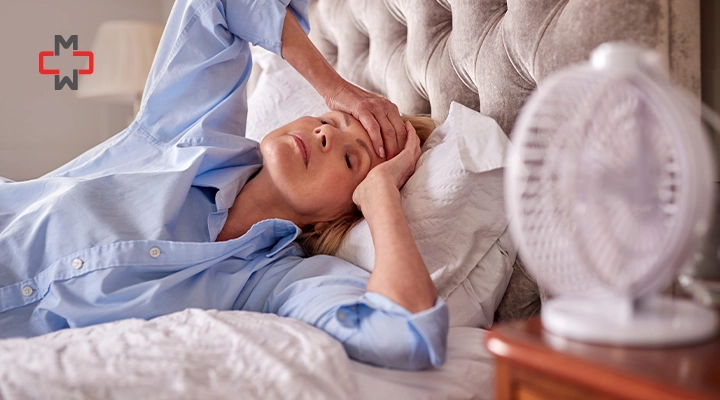
Hot flashes are the symptom most associated with menopause — but they frequently begin years earlier in perimenopause, and may be mild enough that women dismiss them as ‘just getting warm.’ A sudden wave of heat across the chest and face. A flush that reddens the skin. Night sweats that leave the pillow damp without fully waking you.
The mechanism is well-established: estrogen maintains the hypothalamus’s thermoregulatory neutral zone — the temperature range within which no cooling response is triggered. As estrogen fluctuates in perimenopause, this neutral zone narrows, meaning small increases in core body temperature trigger a full cooling response: vasodilation, sweating, a rapid sensation of intense heat. Even occasional, mild hot flashes in a woman in her 40s are a significant clinical signal and should not be dismissed as normal.
SIGN 5 : Hot Flashes or Night Sweats — Even Mild or Occasional
Clinical mechanism: Thermoregulatory zone narrowing via hypothalamic estrogen withdrawal
Hot flashes are the symptom most associated with menopause — but they frequently begin years earlier in perimenopause, and may be mild enough that women dismiss them as ‘just getting warm.’ A sudden wave of heat across the chest and face. A flush that reddens the skin. Night sweats that leave the pillow damp without fully waking you.
The mechanism is well-established: estrogen maintains the hypothalamus’s thermoregulatory neutral zone — the temperature range within which no cooling response is triggered. As estrogen fluctuates in perimenopause, this neutral zone narrows, meaning small increases in core body temperature trigger a full cooling response: vasodilation, sweating, a rapid sensation of intense heat. Even occasional, mild hot flashes in a woman in her 40s are a significant clinical signal and should not be dismissed as normal.
SIGN 6: Irritability or Rage That Feels Disproportionate
Clinical mechanism: GABA decline + serotonin modulation by estrogen
This is one of the symptoms women find most disturbing — and most shameful — because it feels like a character failure rather than a medical symptom. A disproportionate, sudden anger at a minor inconvenience. A hair-trigger irritability that is uncharacteristic of who you have always been. Snapping at people you love. Feeling, afterward, both baffled and distressed by your own reaction.
Estrogen modulates serotonin synthesis, receptor sensitivity, and reuptake in the brain. Serotonin is the neurotransmitter most associated with emotional regulation, patience, and resilience. As estrogen fluctuates in perimenopause, serotonergic tone becomes unstable. The concurrent decline in progesterone-GABA activity removes another buffer. The result is a nervous system that is both under-calmed and emotionally dysregulated — primed for outsized reactions to manageable stressors. This is a hormonal symptom, not a personality change.
SIGN 7 : Vaginal Dryness or Changes in Sexual Comfort
Clinical mechanism: Early genitourinary syndrome of menopause (GSM)
Vaginal dryness is most commonly associated with postmenopause, but it can begin during perimenopause — quietly, and often before women recognise it as hormonal. Reduced natural lubrication, increased friction during sex, a feeling of irritation or sensitivity that wasn’t previously present, or a mild burning or itching that comes and goes.
Estrogen is responsible for maintaining the thickness, elasticity, and lubrication of vaginal tissue. As estrogen levels begin perimenopausal fluctuations, vaginal epithelium can begin to thin and lose moisture-retaining capacity. This early onset of genitourinary syndrome of menopause (GSM) is progressive if untreated, and responds excellently to topical vaginal estrogen therapy — even in early perimenopause. It is a tissue-level response to estrogen insufficiency. Do not wait until symptoms are severe before seeking evaluation.
SIGN 8: Joint Pain and Muscle Aches With No Obvious Cause
Clinical mechanism: Anti-inflammatory role of estrogen in synovial tissue
A new stiffness in the morning that takes 20 minutes to resolve. Achy knees that weren’t achy before. A soreness in the hands, wrists, or shoulders that moves around and has no injury to explain it. Muscle discomfort after exercise that seems disproportionate to the exertion.
Estrogen has significant anti-inflammatory properties throughout the body, including in the joints. Synovial tissue — the membrane that lines and lubricates joints — contains estrogen receptors, and estrogen actively modulates inflammatory cytokines that drive joint pain and swelling. As estrogen begins to decline in perimenopause, this anti-inflammatory protection diminishes. The result is a musculoskeletal discomfort that can feel like early arthritis or fibromyalgia — and that leads many perimenopausal women through unnecessary specialist referrals before the hormonal connection is made.
SIGN 9: Heart Palpitations or Racing Heart
Clinical mechanism: Estrogen’s role in autonomic nervous system regulation
A sudden awareness of your heartbeat. A brief flutter or racing sensation. Occasional skipped beats or a pounding feeling that comes on without physical exertion. Palpitations in otherwise healthy perimenopausal women are distressing precisely because they mimic cardiac symptoms — and many women are sent to cardiology for investigations that return normal results, without anyone considering the hormonal context.
Estrogen modulates the autonomic nervous system, influencing the balance between the sympathetic and parasympathetic branches that govern heart rate and vasomotor tone. As estrogen fluctuates in perimenopause, autonomic stability decreases and the heart’s electrical system becomes more susceptible to irritability. Hot flashes frequently accompany palpitations in perimenopausal women. While palpitations should always be evaluated to rule out primary cardiac arrhythmia, their new appearance in a woman in her 40s alongside other perimenopausal symptoms has a clear hormonal explanation in most cases.
SIGN 10: Hair Thinning and Accelerated Skin Changes
Clinical mechanism: Estrogen and collagen synthesis + androgenic ratio shift
Your hair is falling out more than it used to. Your ponytail is thinner. New fine lines are appearing faster than you expected. Your skin feels drier, less plump, and less resilient — even with the same skincare routine that worked for years.
Estrogen plays a central role in collagen synthesis. The skin contains estrogen receptors throughout the dermis, and estrogen directly stimulates fibroblasts — the cells that produce collagen and maintain skin thickness and elasticity. As estrogen declines in perimenopause, collagen production falls and fine lines deepen more rapidly. The ratio between estrogen and androgens also shifts, with androgens becoming relatively more dominant — accelerating scalp hair thinning while sometimes increasing facial hair growth. These changes are not simply aging. They have a specific hormonal driver and respond to hormone therapy alongside targeted skincare and nutritional interventions.
SIGN 11 : Fatigue That Sleep Does Not Fix
Clinical mechanism: Mitochondrial estrogen signalling + HPA axis dysregulation
You slept eight hours. You feel exhausted. A bone-deep, cellular tiredness that does not respond to rest, caffeine, or willpower. A flatness in energy that makes previously manageable days feel effortful. A sense that your baseline capacity has simply dropped.
Estrogen directly influences mitochondrial function — mitochondria are the cellular power plants that produce ATP, the body’s primary energy currency. Estrogen receptors in mitochondria regulate their efficiency and response to metabolic demand. As estrogen declines, mitochondrial signalling becomes less efficient and energy production falls. Concurrently, the HPA axis governing cortisol can become dysregulated in perimenopause, contributing to a cortisol pattern that is either blunted (low motivation, flat affect) or dysrhythmic (energy crashes at unexpected times). This is not laziness and it is not depression — though perimenopausal fatigue and depression can coexist.
SIGN 12: Your Blood Test Was Normal But Something Still Feels Wrong
Clinical mechanism: FSH unreliability in early perimenopause
This may be the most important sign of all — because it is the one that keeps women stuck. You went to your doctor. You described your symptoms. You had blood work. The results came back within normal range. You were told nothing is wrong. And yet everything still feels wrong.
Here is why this happens. FSH — follicle-stimulating hormone, the standard blood test for menopausal status — fluctuates wildly in perimenopause from week to week and month to month. On the day your blood was drawn, your FSH may have been entirely within the normal premenopausal range — even if earlier that week it was elevated and your ovaries are undeniably in transition. A single normal FSH does not rule out perimenopause. Clinical symptom assessment — the pattern, timing, and character of your symptoms relative to your menstrual cycle — is more diagnostically accurate in early perimenopause than any single blood test. If your symptoms match this list and your FSH is ‘normal,’ you are not making it up. You need a clinician who evaluates perimenopause by clinical presentation, not only by labs.
Perimenopause Symptom Checklist
Check each symptom that is new for you, arrived in your late 30s or 40s, or appears to correlate with your menstrual cycle:
- Periods that have changed in timing, flow, or duration
- New anxiety — especially premenstrual or cyclical
- Sleep disruption — difficulty staying asleep or early morning waking
- Brain fog — word-finding difficulty, poor concentration, memory lapses
- Hot flashes or night sweats — even mild or occasional
- Irritability or rage that feels disproportionate
- Vaginal dryness or changes in sexual comfort
- Joint pain or muscle aches with no obvious cause
- Heart palpitations or racing heart
- Hair thinning or accelerated skin aging
- Fatigue that sleep does not fix
- Normal blood tests that do not match how you feel
| Score: If you checked 3 or more — particularly if they are new and correlate with your menstrual cycle — a perimenopause evaluation with Dr. Syra Hanif, M.D. at Manhattan Medical Arts is appropriate.
Call or walk in: 646-454-9000 • Self-pay • HSA/FSA accepted • Same-day appointments available |
What to Do Next
If you recognise yourself in three or more of the signs above — and especially if you have been told your labs are normal, or that it’s ‘just anxiety’ — you deserve a clinical evaluation by a physician who takes perimenopause seriously.
At Manhattan Medical Arts, Dr. Syra Hanif, M.D. evaluates perimenopause by clinical presentation — not by a single FSH result. A comprehensive perimenopause consultation includes a detailed symptom history, cycle pattern analysis, targeted hormonal and metabolic blood work, and a discussion of evidence-based treatment options including bioidentical hormone therapy, targeted supplementation, and lifestyle optimization.
You do not have to keep explaining yourself to providers who are not listening. You do not have to accept ‘your labs are normal’ as a complete answer. And you do not have to wait until your periods have completely stopped to seek care. Perimenopause is a treatable hormonal transition. The earlier it is identified, the better the outcomes — for your symptoms, your sleep, your cognition, your bones, and your cardiovascular health.
| 📞 Call or Walk In
646-454-9000 Same-day & walk-in available |
🏥 Manhattan Medical Arts
Dr. Syra Hanif, M.D. Self-pay · HSA/FSA accepted · Superbill provided |
Frequently Asked Questions
Can I be in perimenopause if I'm 38?
Yes. Perimenopause can begin in the mid-to-late 30s. The average age of onset is 47, but the range is wide — and early perimenopause before 40 is more common than most women are told. If you are experiencing three or more of the signs above, particularly if they are new and correlate with your menstrual cycle, perimenopause is worth evaluating regardless of your age.
Why does my doctor say my labs are normal?
FSH — the standard blood test for menopausal status — fluctuates dramatically throughout perimenopause. On the day your blood was drawn, your FSH may have been within the normal range even if your ovaries are undeniably in transition. A single normal FSH does not rule out perimenopause. Clinical assessment of symptoms and cycle changes is more diagnostically accurate in early perimenopause than any single blood test. Dr. Syra Hanif, M.D. at Manhattan Medical Arts evaluates perimenopause by clinical presentation, not by a single FSH result.
How is perimenopause anxiety different from an anxiety disorder?
Perimenopause-related anxiety is typically new in the 40s without prior history; cyclical and often worse in the week before the period; accompanied by other hormonal symptoms (sleep changes, brain fog, hot flashes); and does not respond fully to standard anxiety treatments. Primary anxiety disorder tends to be more pervasive, worry-focused, and less cycle-correlated. Many women have both — hormone therapy addresses the hormonal component while psychological support addresses the rest. The two are not mutually exclusive.
How long does perimenopause last?
Perimenopause typically lasts between 4 and 10 years. The transition ends and menopause is reached when 12 consecutive months have passed without a menstrual period. Symptoms are treatable at every stage of perimenopause, and you do not have to wait until menopause is confirmed to seek care.
What treatment is available for perimenopause symptoms?
Evidence-based treatment options include: bioidentical hormone therapy (transdermal estradiol and micronized progesterone adjusted for the perimenopausal environment); targeted supplementation (magnesium glycinate for sleep and anxiety, Vitamin D3/K2 for bone health); lifestyle optimization (resistance training, protein intake, sleep hygiene); and, where indicated, low-dose SSRIs or SNRIs for vasomotor and mood symptoms in women who are not candidates for HRT. At Manhattan Medical Arts, Dr. Syra Hanif, M.D. builds individualized treatment plans based on the full clinical picture.

-
About The Author
Dr. Syra Hanif M.D.Board Certified Primary Care Physician

Dr. Syra Hanif is a board-certified Primary Care Physician (PCP) dedicated to providing compassionate, patient-centered healthcare.
Read More