


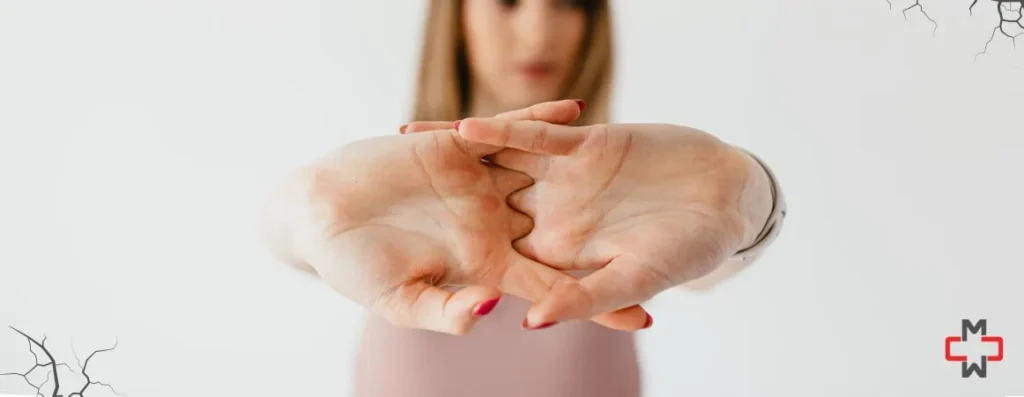
Ordinary, painless knuckle cracking has not been shown to cause arthritis or significant long-term joint damage. Research does not establish that habitual cracking weakens grip strength, loosens joints, or wears away cartilage. Forceful cracking is different because excessive joint manipulation can cause injury. Pain, swelling, stiffness, locking, deformity, or loss of motion also points to a joint problem that deserves medical evaluation. (JABFM)
Does Cracking Your Knuckles Cause Arthritis?
No evidence shows that habitual knuckle cracking increases the risk of hand osteoarthritis.
One of the strongest direct studies examined 215 adults ages 50 to 89 and compared people with radiographic hand osteoarthritis with those without it. Osteoarthritis was present in 18.1% of habitual knuckle crackers versus 21.5% of non-crackers, with no significant association between arthritis and knuckle cracking. The researchers also found no relationship between osteoarthritis and the number of years or cumulative amount of knuckle cracking. (JABFM)
That distinction matters because osteoarthritis involves changes throughout the joint, including cartilage and underlying bone. Knuckle cracking creates a sound within a synovial joint, but the sound itself is not evidence that cartilage is grinding away.
Current clinical guidance continues to reflect the same conclusion: routine knuckle cracking has not been demonstrated to cause osteoarthritis. (ColumbiaDoctors)
If you already have painful, stiff, or swollen joints, the cracking sound and the underlying condition need to be considered separately. MMA’s information on osteoarthritis explains how osteoarthritis itself can produce pain, stiffness, reduced movement, and grating or crackling sensations.
What Actually Happens When You Crack Your Knuckles?
Knuckle cracking occurs when the joint surfaces are pulled apart enough to produce a rapid pressure change and gas-cavity formation inside the synovial fluid.
Most finger knuckles are synovial joints. They contain synovial fluid, which lubricates the joint and allows the bones to move smoothly.
When you pull, bend, or otherwise distract a finger joint:
-
The joint space expands.
-
Pressure inside the joint falls rapidly.
-
Dissolved gases in the synovial fluid participate in formation of a gas-filled cavity.
-
A rapid physical event inside the joint produces the familiar crack.
The sound is therefore not bones striking or grinding against one another.
That is also why a painless intentional knuckle crack is different from persistent grinding or creaking that occurs whenever an arthritic or injured joint moves.
What Causes the Knuckle-Cracking Sound?
Scientists agree that gas-cavity dynamics inside synovial fluid are central to knuckle cracking, but the precise event responsible for the audible sound remains scientifically nuanced.
Older explanations often stated that a gas bubble forms and then completely collapses to create the pop.
Real-time MRI changed that understanding.
A 2015 study directly imaged 10 metacarpophalangeal joints as they cracked. The audible event occurred at the same time as rapid cavity formation, and the cavity remained visible afterward. That finding argued against complete bubble collapse being the entire explanation. (PLOS)
A 2018 mathematical model then showed that partial collapse of a cavitation bubble could generate acoustic signals consistent with knuckle cracking while still leaving residual gas in the joint. (Nature)
The best summary is therefore:
Knuckle cracking involves rapid joint separation and cavitation inside synovial fluid. Imaging supports cavity formation during the crack, while modeling suggests partial cavity collapse can contribute to the sound.
So the common statement that knuckles crack simply because “gas bubbles pop” is an oversimplification.
Does Knuckle Cracking Weaken Your Grip?
Current evidence does not establish that habitual knuckle cracking reduces grip strength.
This question is interesting because research has produced different findings over time.
A 1990 observational study evaluated 300 adults, including 74 habitual knuckle crackers. It found no greater prevalence of arthritis among crackers, but habitual crackers had more hand swelling and lower measured grip strength. (PubMed)
That older result is often quoted as proof that knuckle cracking weakens the hands.
Later studies did not confirm it.
A 2017 study compared 35 habitual knuckle crackers with 35 matched non-crackers. Grip strength was similar between the groups. (PubMed)
Another 2017 prospective study evaluated 400 finger joints in 40 adults. Researchers found no significant difference between habitual crackers and non-crackers in grip strength, self-reported hand disability, swelling, or joint laxity. (PubMed)
So the evidence is better summarized this way:
| Claimed Effect | What Research Shows |
|---|---|
| Reduced grip strength | One older observational study found an association; later controlled studies did not confirm it |
| Hand swelling | Reported in an older study; not reproduced in the 2017 prospective study |
| Joint weakness | Not established |
| Functional impairment | Not consistently demonstrated |
Habitual cracking therefore should not be described as a proven cause of hand weakness.
Does Knuckle Cracking Damage Cartilage?
Research has not demonstrated progressive cartilage erosion from ordinary habitual knuckle cracking.
This directly contradicts the common claim that every crack creates microscopic cartilage wear.
In the 2017 study of 35 habitual crackers and 35 non-crackers, ultrasound measurements actually showed greater metacarpal-head cartilage thickness among habitual crackers. Grip strength remained similar between the groups. (PubMed)
That finding does not prove that knuckle cracking improves cartilage. The researchers themselves noted that the biological significance of increased cartilage thickness remained uncertain and required further study. (ScienceDirect)
What it does show is that existing research does not support a simple relationship such as:
repeated cracking → cartilage wears away → arthritis develops.
The larger osteoarthritis study likewise found no relationship between cumulative cracking exposure and hand osteoarthritis. (JABFM)
Does Knuckle Cracking Make Your Joints Loose or Unstable?
Habitual knuckle cracking has not been shown to cause clinically meaningful joint laxity or instability.
The 2017 prospective study specifically tested habitual crackers for joint laxity, swelling, grip weakness, and range of motion.
Researchers found no significant difference in laxity between habitual crackers and non-crackers. They also observed no swelling following cracking. (PubMed)
Interestingly, joints that produced an audible crack showed a small immediate increase in range of motion after cracking. The researchers did not find evidence of immediate harmful physical changes. (PubMed)
That does not mean cracking is a treatment for joint stiffness.
It means the evidence does not support telling people that ordinary cracking routinely stretches their ligaments until the joints become unstable.
Can Forceful Knuckle Cracking Cause an Injury?
Yes. Forceful joint manipulation can cause an acute injury, even though ordinary painless knuckle cracking is generally benign.
This distinction is important.
Intentional cracking that occurs easily and without pain is very different from aggressively twisting, pulling, or forcing a finger beyond its comfortable range.
Rare reports describe injuries involving tendons or other joint structures after excessive force. Current clinical guidance therefore recommends avoiding aggressive manipulation rather than treating every ordinary knuckle crack as harmful. (ColumbiaDoctors)
Stop forcing a joint to crack if you experience:
-
Sharp pain
-
Sudden swelling
-
Visible deformity
-
Loss of movement
-
New weakness
-
A joint that feels unstable after manipulation
A painful crack after trauma needs a different evaluation from a painless crack produced intentionally.
Why Does Cracking Your Knuckles Feel Good?
Knuckle cracking can briefly relieve a feeling of joint tension or stiffness, which helps explain why many people repeat the behavior.
The action stretches the finger joint, and some people describe an immediate sense of release afterward. Clinical sources also note that cracking can become an automatic habit associated with boredom, concentration, nervous energy, or stress. (Scripps.org)
That does not mean the joint medically “needs” to be cracked.
It simply explains why the behavior can feel satisfying.
For most people, knuckle cracking is better understood as a habitual sensory behavior than a treatment for a joint problem.
Do You Need to Stop Cracking Your Knuckles?
No. You do not need to stop ordinary painless knuckle cracking solely to prevent arthritis or joint damage.
Current research does not provide a medical reason to force someone to abandon a painless cracking habit.
A more useful rule is:
Painless + easy + no swelling + normal motion
→ generally reassuring.
Painful + forceful + swollen + stiff + unstable
→ stop manipulating the joint and have the symptoms evaluated.
If you personally dislike the habit, replacing it with finger movement, stretching, or another behavior is reasonable. But ordinary knuckle cracking does not require a treatment program simply because it makes a popping sound.
When Is Joint Cracking or Popping a Medical Concern?
Joint sounds deserve evaluation when they occur with pain, swelling, stiffness, locking, instability, deformity, or loss of movement.
The sound itself matters less than the symptoms occurring with it.
| Joint Finding | What It Means Clinically |
|---|---|
| Intentional painless pop | Usually consistent with ordinary joint cracking |
| Painful pop after injury | Possible sprain or structural injury |
| Grinding or grating during movement | Different from ordinary cavitation; can occur with degenerative joint changes |
| Finger catches or locks | Can involve a tendon or trigger-finger-type problem |
| Persistent swelling | Not explained by harmless knuckle cracking alone |
| Redness or warmth | Can indicate inflammation or infection |
| Joint feels unstable | Needs structural evaluation |
| Visible deformity | Requires prompt assessment |
| Reduced range of motion | Can reflect injury, arthritis, inflammation, or another joint disorder |
This distinction is particularly important for osteoarthritis.
Osteoarthritis itself can produce grating, popping, or crackling during ordinary movement, along with pain, stiffness, swelling, and reduced mobility. (Manhattan Medical Arts)
That is not the same process as deliberately pulling a painless knuckle until it cracks.
MMA’s joint pain guide covers symptoms such as persistent pain, stiffness, swelling, warmth, redness, and restricted movement that require medical assessment. (Manhattan Medical Arts)
What Does Research Actually Show About Long-Term Knuckle Cracking?
The strongest available evidence is reassuring overall, but the research base is relatively small.
A fair evidence summary looks like this:
| Question | Current Evidence |
|---|---|
| Does it cause arthritis? | No demonstrated association |
| Does cracking frequency increase arthritis risk? | No demonstrated association |
| Does it weaken grip? | Not established; later studies found no difference |
| Does it cause swelling? | One older association, not consistently reproduced |
| Does it loosen joints? | Controlled study found no significant laxity difference |
| Does it wear cartilage away? | Not demonstrated |
| Does it increase range of motion? | A small immediate increase occurred in one study |
| Can forceful cracking injure a joint? | Yes, rare acute injuries can occur |
| Does painless cracking require treatment? | No evidence-based treatment is necessary |
The key point is not that every possible long-term effect has been disproven forever. The available studies are limited in size and design.
The stronger conclusion is:
Existing clinical research has not demonstrated that ordinary habitual knuckle cracking causes osteoarthritis, progressive cartilage damage, chronic joint instability, or loss of grip strength.
How Manhattan Medical Arts Can Help With Painful or Abnormal Joint Symptoms
Painless knuckle cracking generally does not need medical treatment, but persistent joint pain, swelling, stiffness, warmth, locking, weakness, or reduced movement deserves evaluation.
A primary care clinician can examine the affected joint, review any history of injury, determine whether the symptoms fit an inflammatory, degenerative, tendon-related, or traumatic problem, and coordinate additional testing or specialist care when necessary.
Manhattan Medical Arts evaluates joint symptoms through its primary care services, including concerns involving pain, swelling, stiffness, and injuries.
If cracking or popping has become painful, the important question is no longer whether normal knuckle cracking is harmful. The priority is identifying what is causing the joint symptoms.
This article was medically reviewed by Dr. Syra Hanif, M.D., a board-certified primary care physician at Manhattan Medical Arts. (Manhattan Medical Arts)
Frequently Asked Questions
Can Cracking Your Knuckles Make Your Fingers Bigger?
Ordinary knuckle cracking does not permanently enlarge the finger bones. Persistent swelling or a visible change in joint shape deserves evaluation because another joint condition can be responsible.
Why Can’t You Crack the Same Knuckle Again Immediately?
After a joint cracks, its internal pressure and gas-cavity conditions need time to reset before the same joint can usually produce another crack. This temporary period prevents repeated immediate cracking of the same joint.
Is Cracking Your Toes the Same as Cracking Your Knuckles?
The basic process is similar because toe joints are also synovial joints. Painless occasional cracking is generally different from painful clicking, swelling, or grinding.
Can Children Crack Their Knuckles?
Children can produce normal joint-cracking sounds just as adults can. Painless cracking without swelling or restricted movement is generally reassuring, while recurrent pain or abnormal joint movement deserves medical attention.
Can Knuckle Cracking Affect Hand Growth?
There is no evidence that ordinary knuckle cracking interferes with normal hand or finger growth.
Why Do Only Some of My Fingers Crack?
Individual joints differ in anatomy, mobility, pressure, and how easily their joint surfaces can be distracted. As a result, some fingers crack easily while others rarely produce a sound.
Does Knuckle Cracking Burn Calories?
No meaningful number of calories is burned by cracking your knuckles. The movement is too brief and involves too little muscular work to affect energy expenditure.
Can You Crack a Knuckle After a Finger Injury?
Avoid deliberately forcing an injured finger to crack while it remains painful, swollen, bruised, or stiff. Manipulation can aggravate an existing injury.
Can Cold Weather Make Your Knuckles Crack More?
Cold temperatures can make joints and surrounding tissues feel stiffer, which can make you more aware of joint movement and the urge to crack them. Increased cracking does not automatically mean the joint is damaged.
Do People With Flexible Joints Crack Their Knuckles More Easily?
Some people with greater joint mobility find it easier to produce joint sounds because their joints move through a wider range. Painful instability or unusually loose joints still deserve medical evaluation.
Final Thoughts
Ordinary painless knuckle cracking has not been shown to cause arthritis or significant long-term joint damage.
A study of 215 adults found no association between habitual cracking, cumulative cracking exposure, and hand osteoarthritis. (JABFM)
Research on grip strength also does not support the claim that habitual cracking routinely weakens the hands. Although a 1990 study reported lower grip strength and more swelling among habitual crackers, later controlled studies found no meaningful grip-strength difference, joint laxity, swelling, or hand disability. (PubMed)
The cracking sound itself results from rapid pressure changes and gas-cavity dynamics inside synovial joints rather than bones grinding together. Research continues to examine whether cavity formation, partial collapse, or both contribute to the acoustic event. (PLOS)
The practical distinction is simple:
Painless intentional cracking without swelling or loss of movement is usually reassuring.
Pain, persistent swelling, warmth, locking, grinding, deformity, weakness, or restricted movement points to a separate joint issue that deserves medical evaluation.
Disclaimer
This blog is for informational & educational purposes only and does not intend to substitute any professional medical advice or consultation. For any health-related concerns, please consult with your physician, or call 911. strength, popping sounds, and when to see a doctor.

-
About The Author
Dr. Syra Hanif M.D.Board Certified Primary Care Physician

Dr. Syra Hanif is a board-certified Primary Care Physician (PCP) dedicated to providing compassionate, patient-centered healthcare.
Read More